Amazon Lookout for Equipment
Amazon Lookout for Equipment is a machine learning service that enables industrial customers to build custom ML models to detect abnormal equipment behavior using their existing sensor data — with an automated machine learning workflow that requires no data science knowledge.
Service Introduction
What is Amazon Lookout for Equipment?
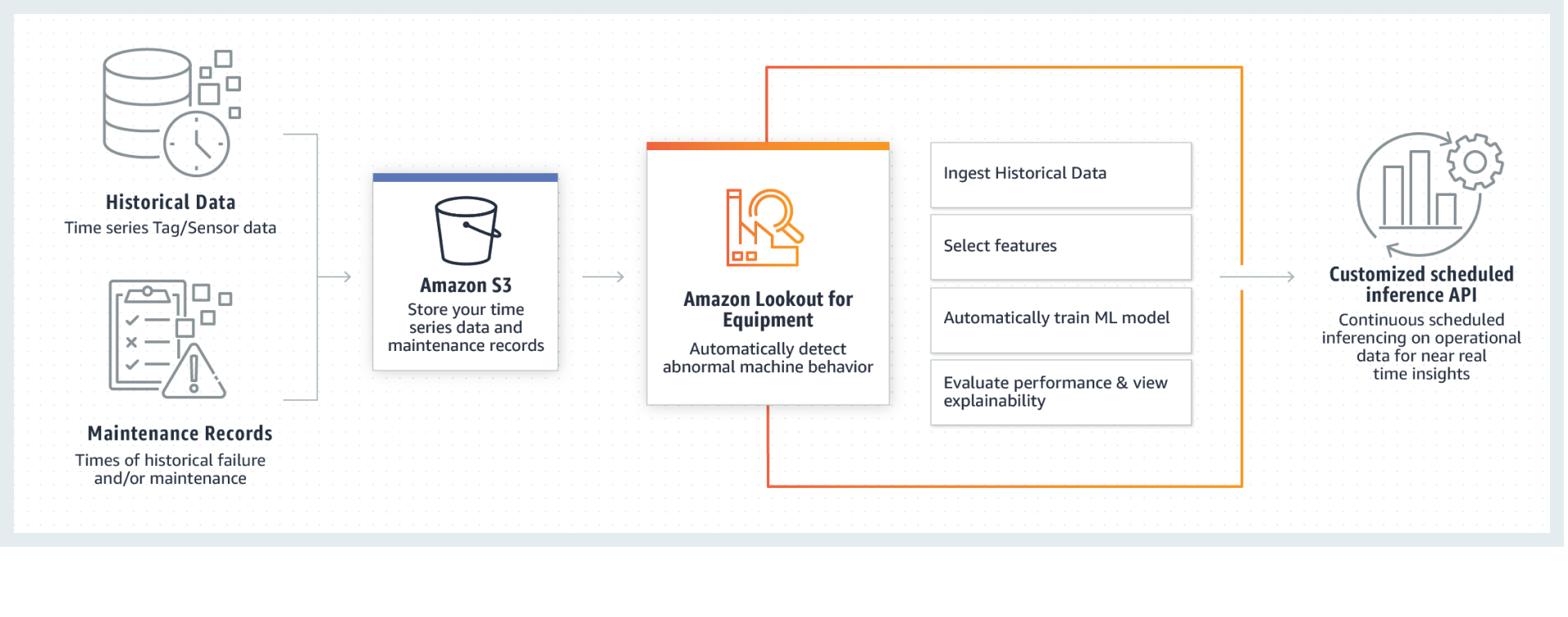
Customers store historical time-series sensor data and maintenance records in Amazon S3. Lookout for Equipment ingests that historical data, helps select features, automatically trains an ML model, and lets users evaluate performance and view explainability — then serves continuous scheduled inference on operational data for near-real-time insights through a customized inference API.
Customer Problems
Building ML models for predictive maintenance is costly. Industrial companies are already streaming enormous volumes of sensor data into the cloud, but modeling equipment behavior and diagnosing issues from that data takes significant investment in time, resources and expertise — a hurdle for scaling across assets, as customers like Koch Ag and Energy Solutions told us. The service answers this with an automated machine learning workflow that requires no data science knowledge.
Target Users
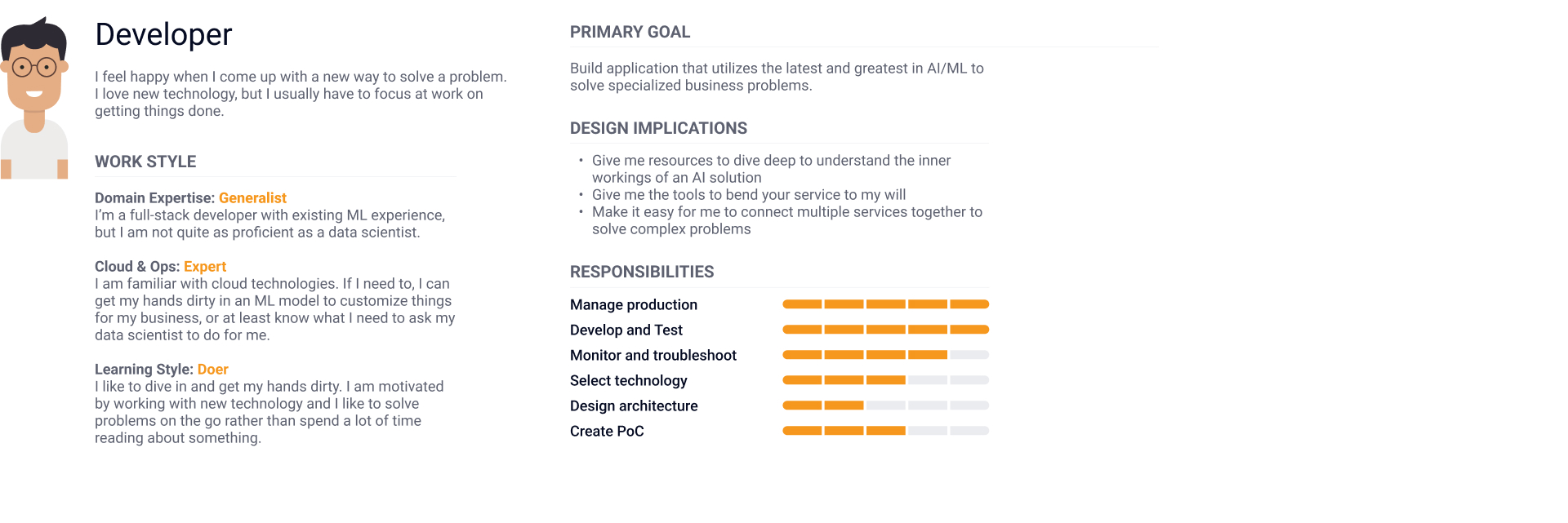
The target users are developers with a basic understanding of machine learning: full-stack builders who are experts in cloud and operations, generalists in ML — hands-on "doers" whose goal is to build applications that use the latest AI/ML to solve specialized business problems. The design implications: give them resources to dive deep into how the AI solution works, tools to bend the service to their will, and easy ways to connect multiple services together.
Product Timeline
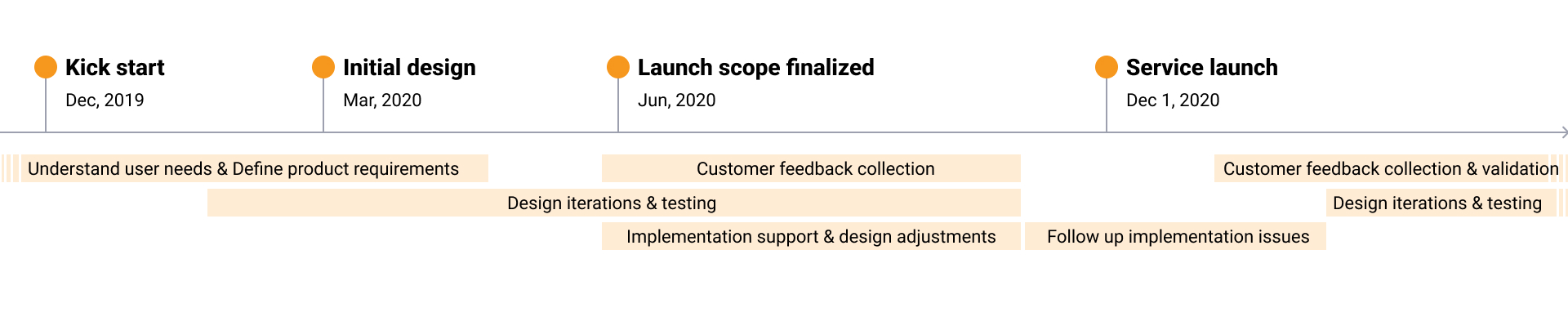
I joined in December 2019 as the sole UX designer, while also leading Amazon Monitron. The project kicked off in December 2019, reached initial design in March 2020, finalized launch scope in June 2020, and the service launched on December 1, 2020 — with UX work spanning user-needs definition, design iterations and testing, customer feedback collection, and implementation support throughout.
Role & Challenges
My Role & Team
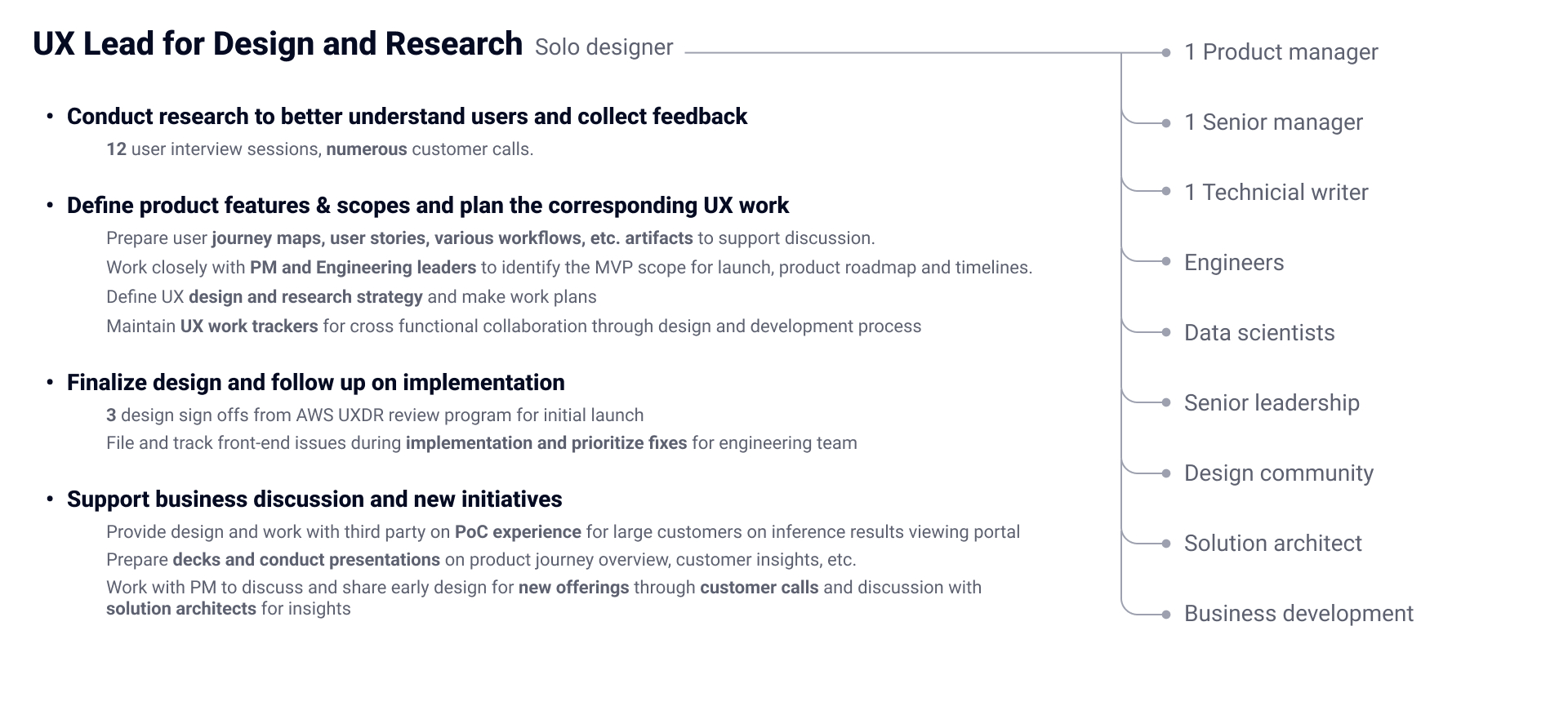
As UX lead for design and research — and solo designer — I worked from defining the vision through MVP prioritization, customer PoCs, and post-launch improvements, collaborating with one product manager (who joined at the same time), a senior manager, a technical writer, engineers, data scientists, senior leadership, the design community, solution architects, and business development.
- Conduct research to better understand users and collect feedback — 12 user interview sessions and numerous customer calls
- Define product features & scope and plan the UX work — journey maps, user stories and workflow artifacts to support discussion; MVP scope, roadmap and timelines with PM and engineering leaders; UX design and research strategy; UX work trackers for cross-functional collaboration
- Finalize design and follow up on implementation — 3 design sign-offs from the AWS UXDR review program for initial launch; filing and prioritizing front-end issues with engineering
- Support business discussion and new initiatives — PoC experience with a third party for large customers, decks and presentations on the product journey and customer insights, early designs for new offerings explored through customer calls and solution architects
Challenges
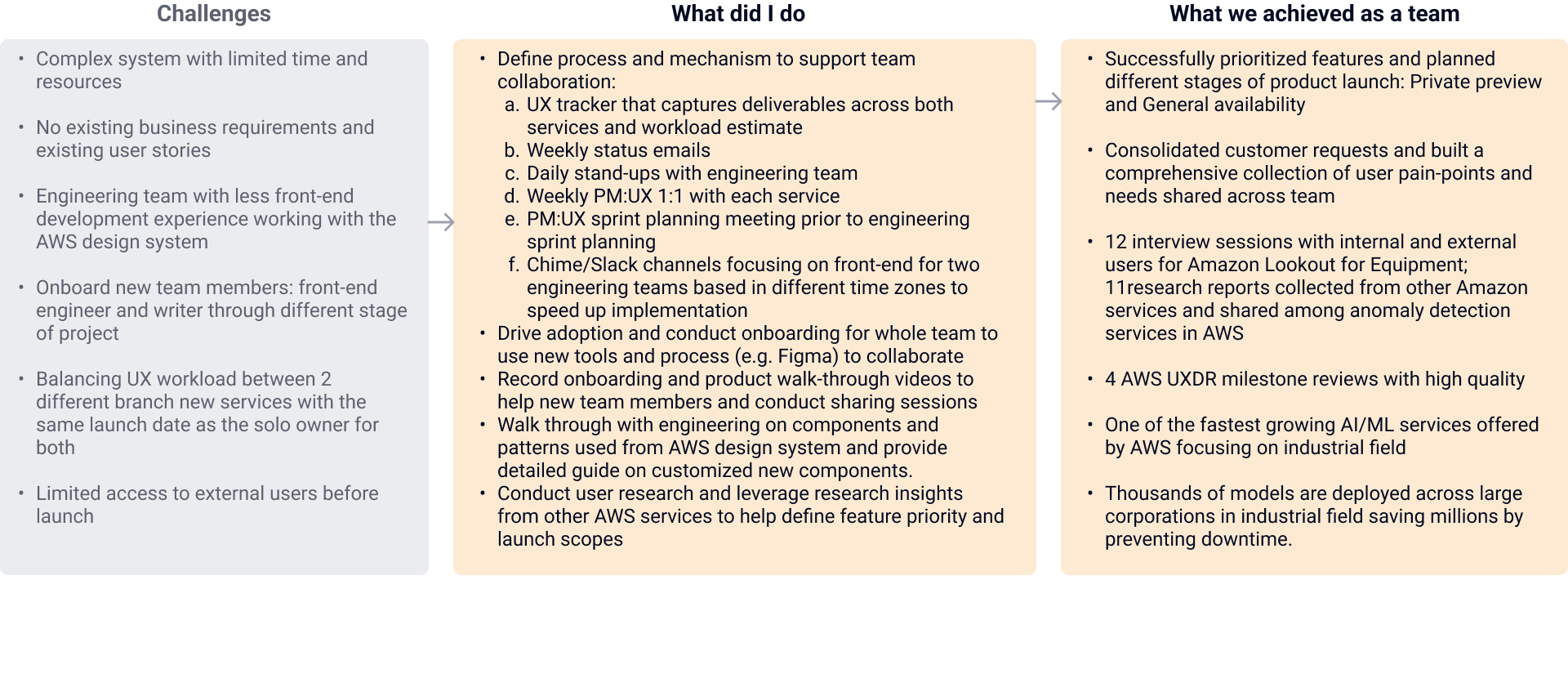
- Complex system with limited time and resources
- No existing business requirements or user stories
- Engineering team with less front-end development experience working with the AWS design system
- Onboarding new team members — front-end engineer and writer — through different stages of the project
- Balancing UX workload between two brand-new services with the same launch date, as the solo owner for both
- Limited access to external users before launch
Design Process & Results
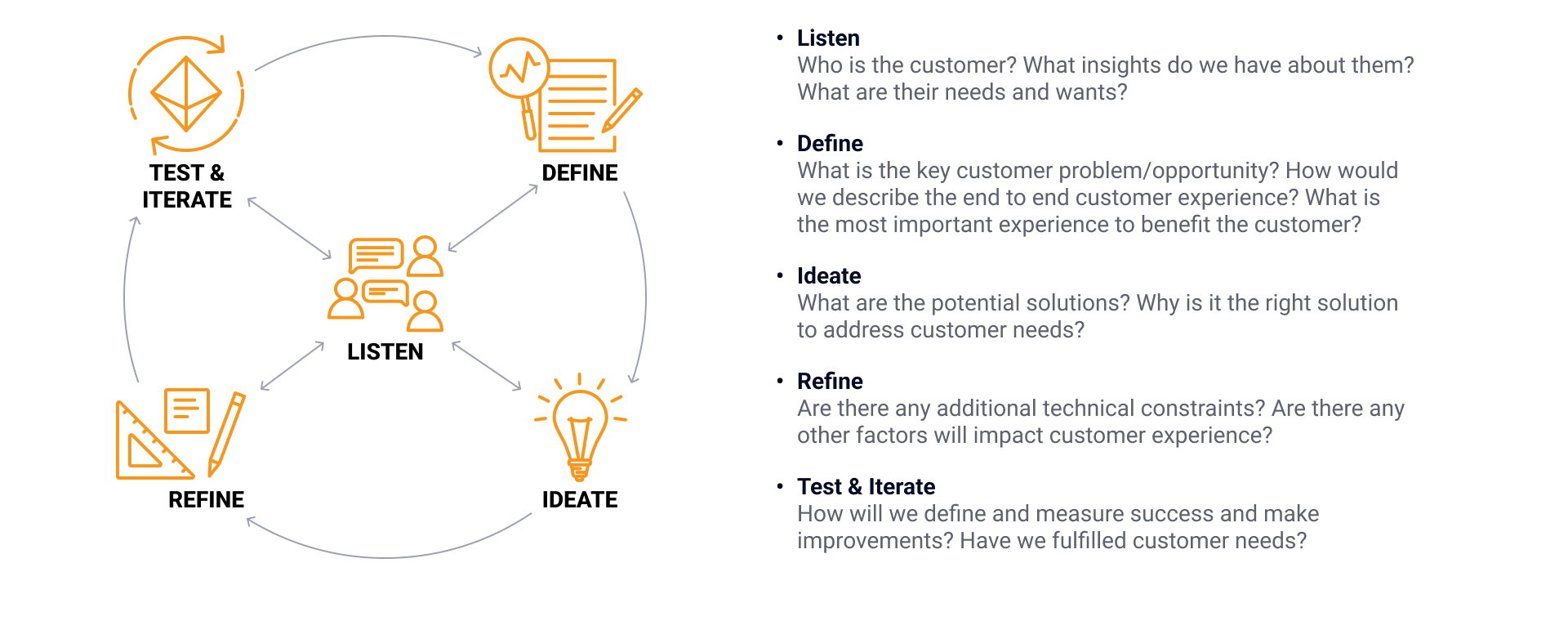
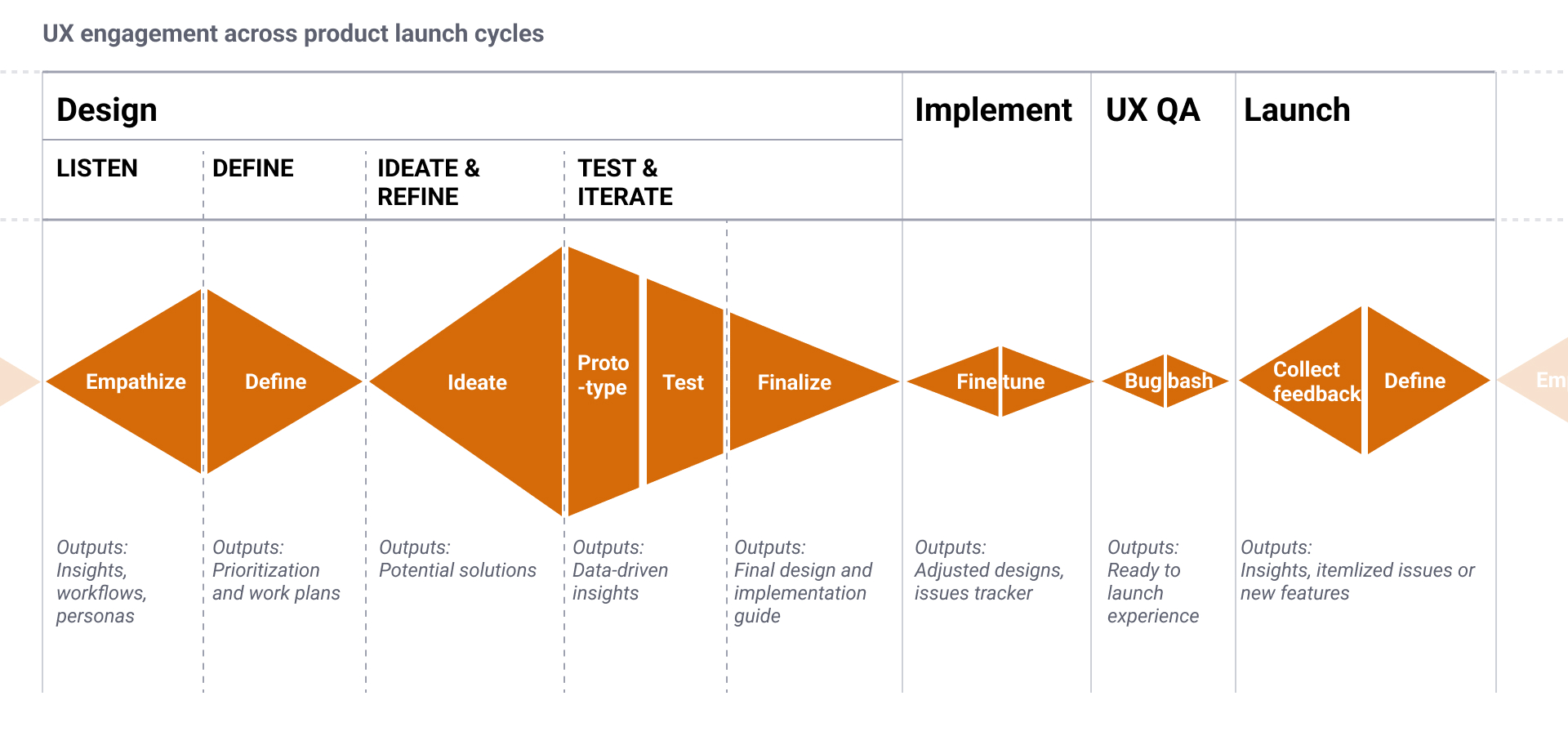
The process ran as a continuous cycle with the user at the center — Listen, Define, Ideate, Refine, Test & Iterate — asking at each stage: who is the customer and what are their needs? What is the key problem and the most important experience to benefit them? What are the potential solutions? What technical constraints apply? And how do we measure success and improve? UX engaged across the full launch cycle: design, implementation, UX QA, launch, and back into collecting feedback.
Clarify the Workflows
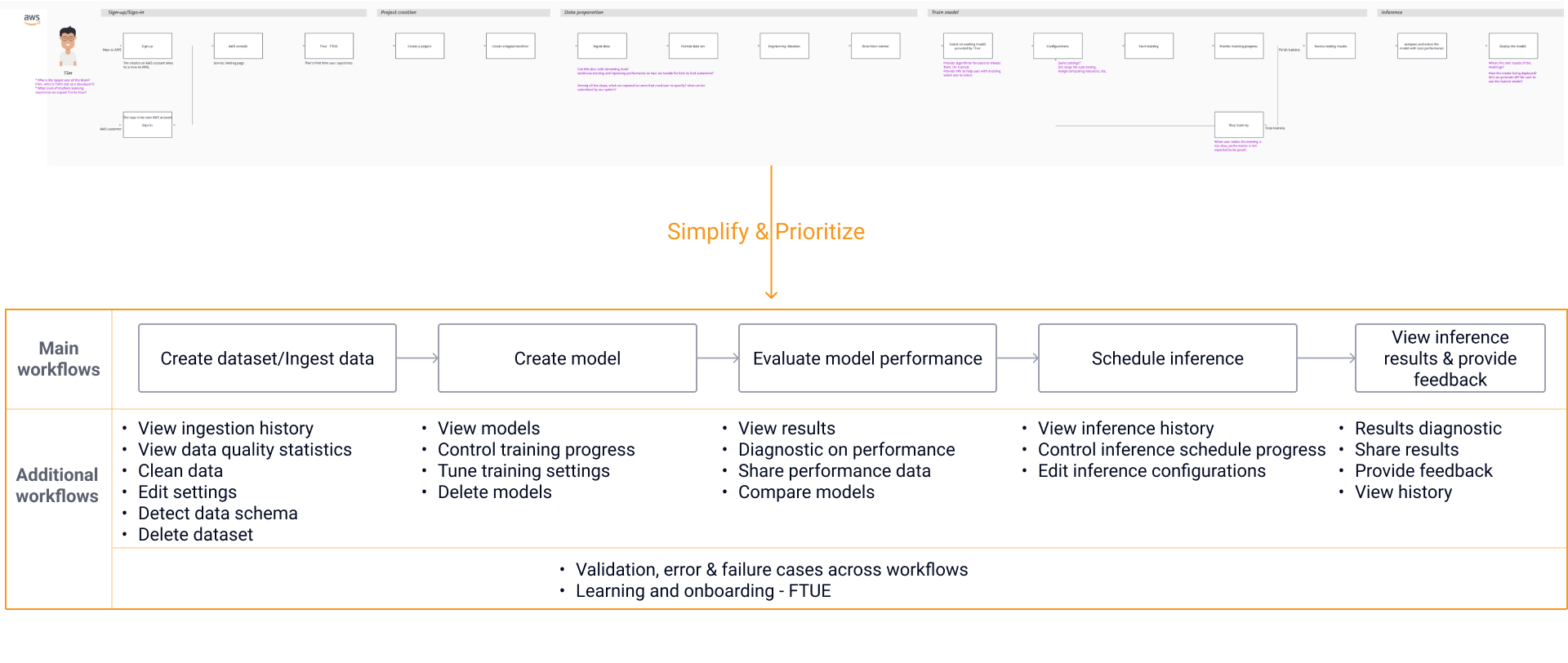
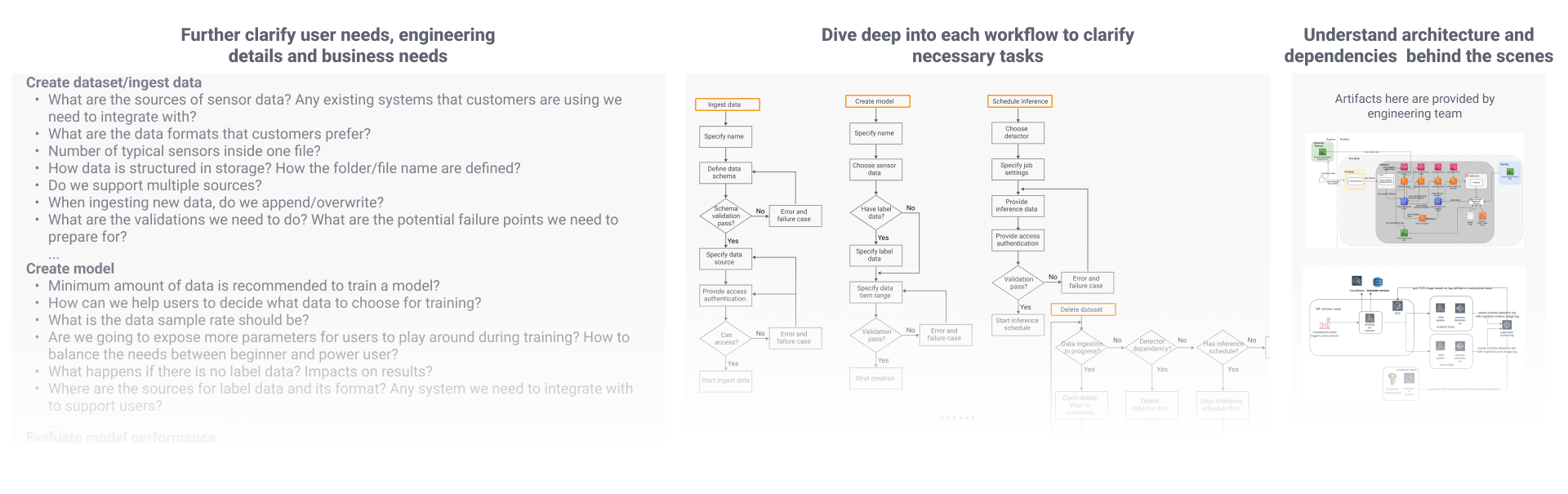
I created high-level workflow diagrams to facilitate discussions with PM, engineering, and science teams, simplifying a sprawling end-to-end journey into five main workflows: create dataset/ingest data, create model, evaluate model performance, schedule inference, and view inference results & provide feedback — the last deprioritized for the initial AWS console scope.
Prioritization & Launch Scope
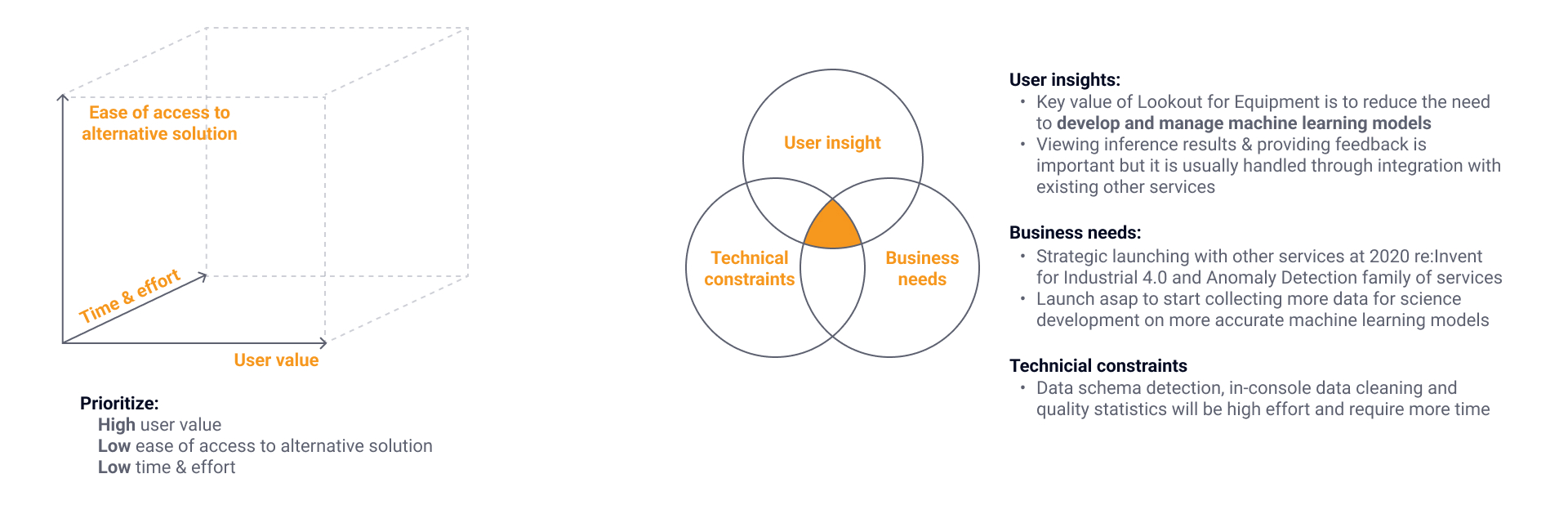
User insights, business needs, and technical constraints together informed scope: prioritize what has high user value, low ease of access to an alternative solution, and low time & effort. Users told us the key value of Lookout for Equipment is reducing the need to develop and manage ML models, and that inference-results viewing is usually handled through integration with existing services. The business needed a strategic launch at re:Invent 2020 alongside the Industrial 4.0 and Anomaly Detection family of services — and to start collecting data early for more accurate models. Technically, data schema detection and in-console data cleaning would be high-effort. So data schema detection and quality statistics ranked highest among post-launch features, while inference-results viewing received the lowest priority given white-glove enterprise offerings.
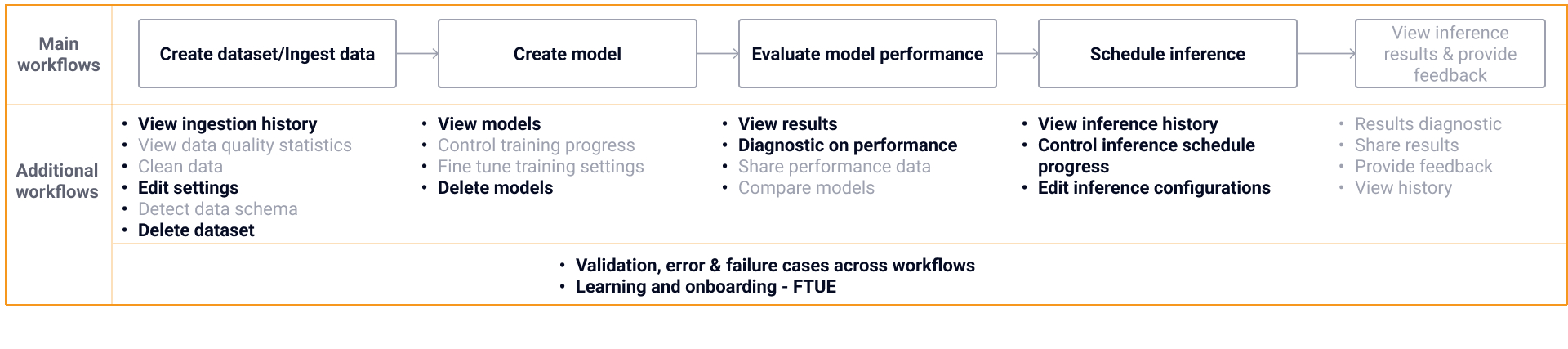
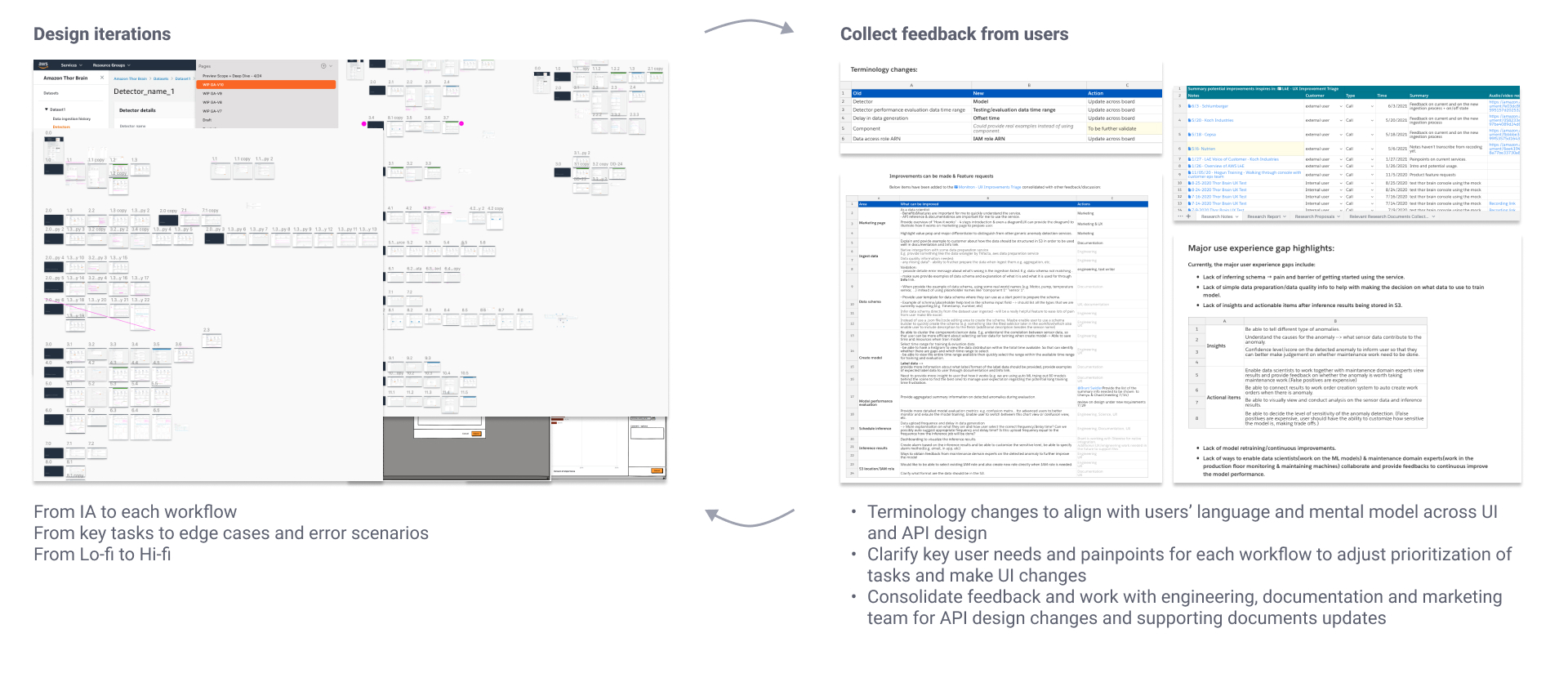
I then dove deep into each workflow with PM, science, and engineering — clarifying user needs, engineering details and business needs per workflow, documenting comprehensive scenarios including validation, error and failure cases, and first-time-user onboarding. From there I established the overall framework and information architecture, and iterated on each workflow: from IA to each workflow, from key tasks to edge cases and error scenarios, from lo-fi to hi-fi. Validation combined testing with 10+ internal users using prototypes and joining customer calls through PM and business development — feeding terminology changes to align with users' mental models across UI and API design, prioritization adjustments, and consolidated feedback for engineering, documentation and marketing.
From Insights to Design
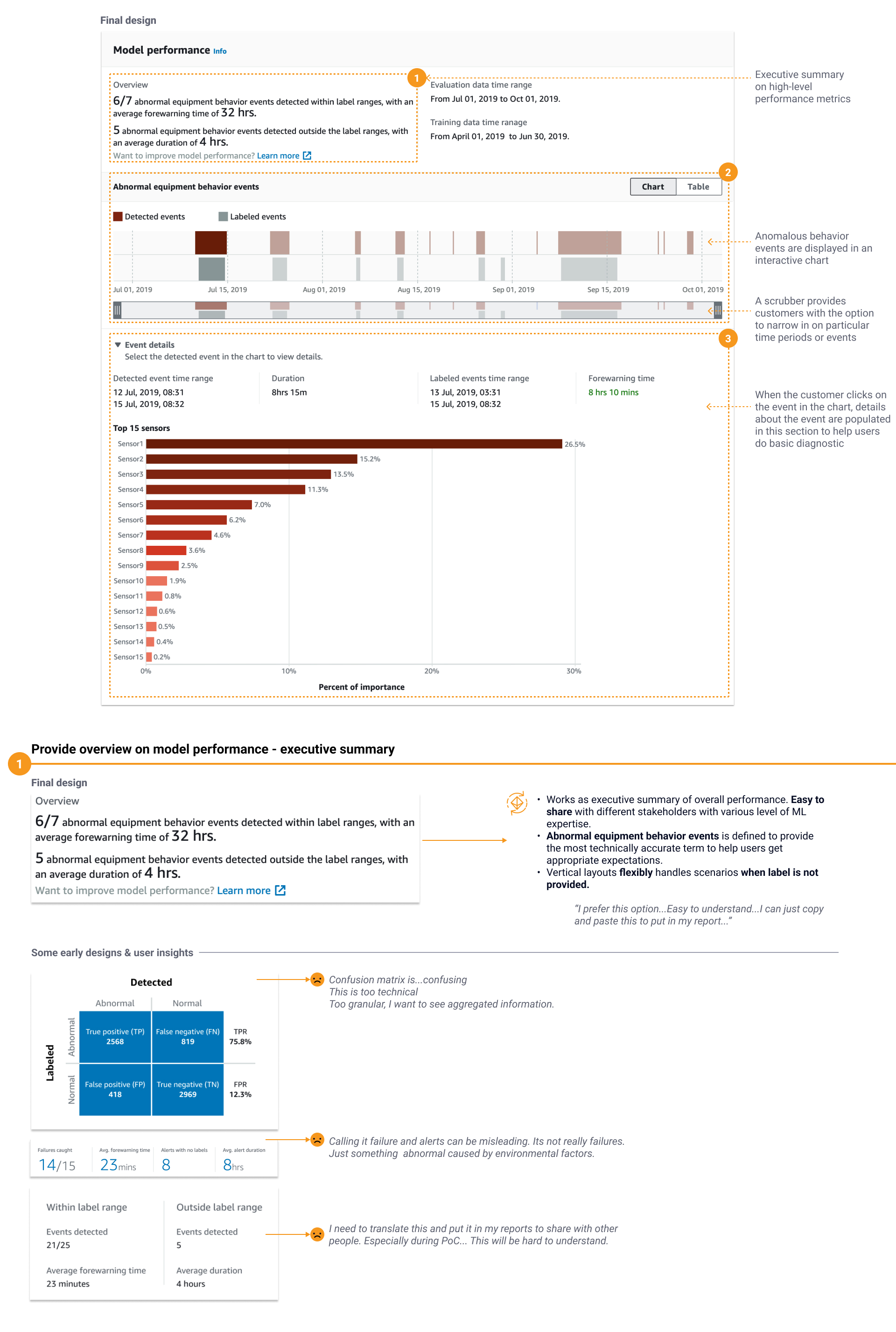
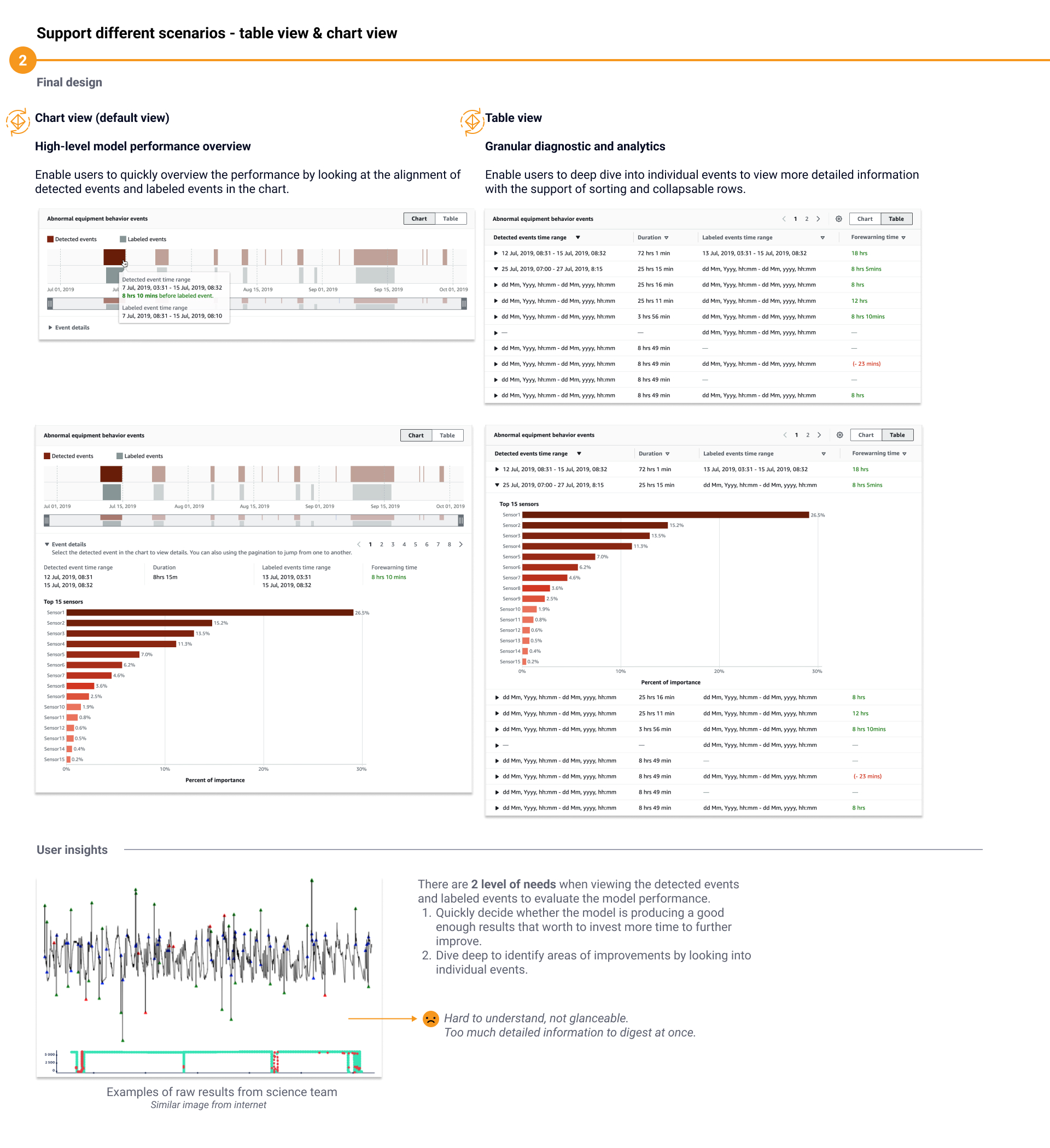
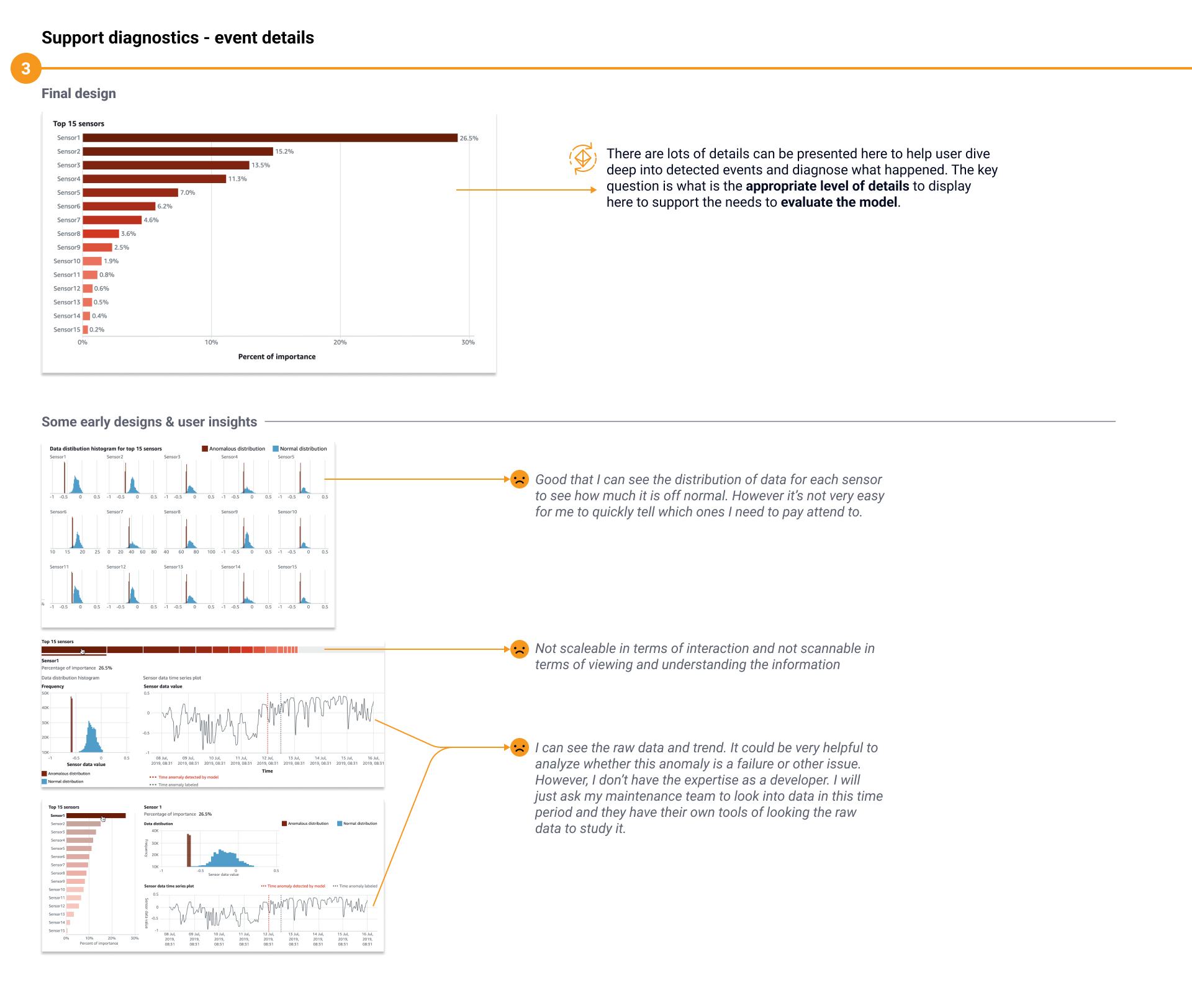
Design evaluation prioritized four intents: easy to understand (help users complete tasks easily), flexible (accommodate future changes and foreseeable needs), consistent (align with the design system across AWS services), and accurate (technically precise, to avoid confusion and set the right expectations). Applied to model performance evaluation, that meant: an executive summary of high-level metrics users can copy straight into reports (early confusion-matrix concepts tested as "too technical, too granular"); a chart view for quickly judging whether a model is good enough alongside a table view for deep-diving individual events; and event details with the appropriate level of diagnostic depth — top contributing sensors rather than raw data dumps that users said they'd hand off to maintenance teams anyway.

What We Accomplished
The service previewed at re:Invent in December 2020 and reached General Availability in April 2021. I actively engaged with preview customers, conducted foundational research, and ran usability testing on prioritized features.
- Successfully prioritized features and planned the product launch stages: private preview and general availability
- Consolidated customer requests into a comprehensive collection of user pain points and needs shared across the team
- 12 interview sessions with internal and external users; 11 research reports collected from other Amazon services and shared among AWS anomaly detection services
- 4 AWS UXDR milestone reviews passed with high quality
- One of the fastest-growing AI/ML services offered by AWS focusing on the industrial field
- Thousands of models deployed across large industrial corporations, saving millions by preventing downtime
Reflection — What I Learned
Owning two brand-new services to the same launch date, solo, is a forcing function: it teaches you to operate at the portfolio level — where the scarce resource isn't design time but decision quality, and where the mechanisms you set up matter more than any single deliverable.
Leadership
- Balancing competing needs under time pressure by making prioritization explicit and visible, so trade-offs were made once — deliberately — rather than re-litigated in every meeting
- Making informed decisions by weighing risks against outcomes, and being clear with the team about which bets we were taking and why
- Building trust through reliable delivery, open communication and transparent sharing — the currency that let design influence scope, sequencing and API decisions beyond the UI
- Actively seeking feedback on my own operating style, and treating every information gap as a signal to pursue another perspective before committing
UX Design & Research
- Deciding amid ambiguity with the best available knowledge — then instrumenting the decision so evidence could correct it quickly
- Using design artifacts — journey maps, workflows, scenarios — as the vehicle for defining user stories and requirements, turning design into the alignment mechanism for PM, science and engineering
- Prototyping and iterating rapidly so user insight arrived while decisions were still cheap to change
- Connecting directly with internal and external users, and pulling the broader org into that signal rather than keeping research a designer-only activity
- Developing genuine subject-matter expertise in predictive maintenance and the industrial domain — the foundation for leading, not just supporting, product conversations